


A tiny kitchen can become frustrating surprisingly quickly. Countertops disappear under appliances, cabinets become difficult to close, and drawers fill with containers and lids that never seem to have a proper place. Add awkward corners, limited pantry space, and too many kitchen gadgets, and even everyday cooking can feel like a storage puzzle.
The good news is that you do not necessarily need a bigger kitchen. You need to make better use of the space you already have.
The most effective approach to maximize storage in a tiny kitchen is to look for unused vertical space, dead corners, cabinet-door surfaces, deep shelves, and awkward areas under the sink. The right organizer can help, but only when it solves a specific problem.
Affiliate disclosure: The links in this article may be affiliate links. If you purchase through one of these links, we may earn a commission at no additional cost to you.
This guide explains where small kitchens commonly waste space, what you can change, and which practical storage products are worth considering.

Table of Contents
1. Make the Walls Work Harder

The problem
Countertops often become the default storage area for cooking utensils, oils, mugs, and other frequently used items.
Why it happens
When cabinets are full, it is easy to leave everyday tools wherever they are easiest to reach. Over time, the counter becomes permanent storage instead of workspace.
Practical solution
Look upward.
A wall-mounted rail can hold utensils, measuring cups, small baskets, or lightweight kitchen tools. A narrow hanging basket can also provide a place for items that would otherwise occupy a drawer.
For example, if cooking oils and frequently used utensils are crowding the counter beside your stove, move suitable items to a wall-mounted rail or narrow wall organizer. The counter can then remain available for chopping and food preparation.
Useful product: Wall-Mounted Kitchen Rail with Hooks

- 【Multipurpose Wall-Mounted Rack】 Measuring 3.35″D x 38″W x 2.56″H with a 1.4” distance from the wall, this versatile rac…
- 【Multi-function Wall Hanger】This wall mount kitchen rail rack can be used for hanging pots, pans and other Utensils. And…
Why it helps:
It moves lightweight everyday tools from the countertop to an unused wall surface.
Where to use it:
Install it near a food-preparation area or cooking zone, provided the wall and installation location are suitable.
Before buying:
- Measure the available wall width.
- Check the mounting method.
- Consider the weight capacity.
- Make sure hooks cannot interfere with nearby cabinets.
- Avoid placing storage where heat or moisture could damage the items.
For renters, an adhesive storage rack may be more practical, but check its weight limit carefully before relying on it.
2. Use the Inside of Cabinet Doors

The problem
The inside surface of a cabinet door is often completely unused.
Why it happens
Most people think about cabinet shelves but forget that the door itself can become a small storage surface.
Practical solution
Use the door for slim, lightweight items that are difficult to organize elsewhere.
Good candidates include:
- Measuring spoons
- Small packets
- Cleaning supplies
- Wraps and bags
- Small kitchen tools
- Pot holders
Avoid placing heavy objects on a door unless the organizer and cabinet hardware are designed to handle the additional load.
Useful product: Kitchen Cabinet Door Organizer

- Measure Before Purchase: Overall Dimensions: 18″W x 50″H x 5″D. Ensure enough depth for the pantry: >5.2 inches, and doo…
- Maximize Storage with Large Capacity: Over the door pantry organizer boasts 6 large baskets(16.22″W x 4.65″D x 2.95″H), …
Why it helps:
It creates storage without taking up an entire shelf.
Where to use it:
Inside suitable pantry, cleaning, or lower cabinet doors.
Before buying:
- Measure the door’s usable width and height.
- Check whether the cabinet door closes with the organizer installed.
- Look for a suitable mounting method.
- Check the organizer’s depth so it does not collide with shelf contents.
- Consider the weight of the items you plan to store.
A slim organizer is usually more practical than a deep one because cabinet-door storage needs to leave enough clearance inside the cabinet.
3. Turn Dead Corners Into Useful Storage

The problem
Corner cabinets can hold plenty of items but still feel nearly impossible to use.
Why it happens
The back portion of a corner cabinet is difficult to reach. Items pushed toward the rear are easily forgotten.
Practical solution
Make the contents move toward you.
A rotating organizer can work well for sauces, condiments, baking ingredients, or smaller containers. Instead of reaching around several objects, you rotate the storage surface and bring the item forward.
Useful product: Rotating Lazy Susan Organizer
![12-Inch Non-Skid Turntable Lazy Susan Organizer [4 Pack] - Spinni...](https://m.media-amazon.com/images/I/41q2l-FL6OL._AC_.jpg)
- [ Please Note ] – The lazy susan is large enough for 12 cans of coke (refer to the 2rd image). Please read the lazy susa…
- Product Include – 4 Pack 12 Inch plastic turntable lazy susans. Diamond-shaped silicone non-slip surface with anti-slip …
Why it helps:
It makes awkward corner storage easier to see and reach.
Where to use it:
Corner cabinets, pantry shelves, or suitable countertop areas.
Before buying:
- Measure the cabinet’s usable diameter and height.
- Check the organizer’s clearance from the cabinet door.
- Make sure it rotates freely.
- Choose a size that does not waste too much surrounding space.
- Consider whether raised edges are useful for preventing smaller containers from sliding.
Do not assume every corner cabinet needs a rotating organizer. Measure first. A poorly sized turntable can actually make the cabinet harder to use.
4. Make Deep Cabinets Easier to Access
The problem
Deep cabinets can technically store many items, but the back of the shelf becomes a storage graveyard.
Why it happens
When something is pushed behind several other items, it becomes inconvenient to retrieve. You may eventually stop using it altogether.
Practical solution
Turn a deep shelf into something that slides.
Group similar items in a pull-out basket or sliding organizer. Instead of removing everything in front, you can pull the storage unit forward and see what is inside.
This is particularly useful for bottles, canned goods, food packages, and cleaning supplies.
Useful product: Pull-Out Cabinet Organizer

- A MUST HAVE PULL OUT DRAWER: This sliding cabinet organizer installs in under 30 minutes and makes it super easy to stor…
Why it helps:
It improves access to the back of deep cabinets.
Where to use it:
Lower cabinets, pantry cabinets, and other deep storage areas with enough clearance.
Before buying:
- Measure cabinet width, depth, and height.
- Check the installation requirements.
- Confirm the organizer can support the intended weight.
- Leave enough room for the unit to slide.
- Check whether hinges or plumbing interfere with installation.
A pull-out organizer is most useful when poor accessibility is the real problem—not simply when a cabinet looks empty.
5. Stop Wasting Under-Sink Space

The problem
The cabinet beneath the sink often contains cleaning products, sponges, bags, and other supplies scattered around pipes.
Why it happens
Plumbing takes up valuable space and makes ordinary shelves or boxes difficult to position.
Practical solution
Choose an organizer designed around the plumbing.
An adjustable under-sink unit can separate cleaning products and smaller supplies while leaving an opening or adjustable section around pipes.
Useful product: Adjustable Under-Sink Organizer
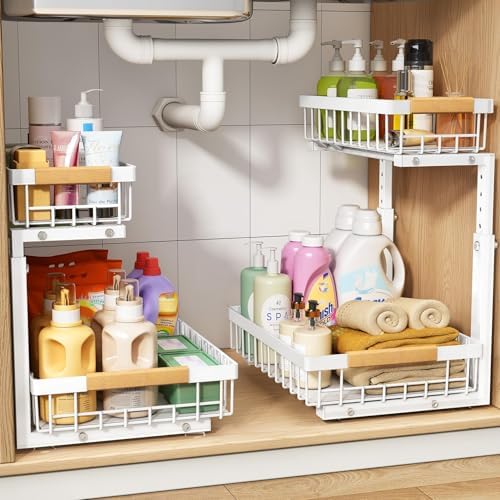
- C Shaped Design-Save Space: The Under Sink Organizer kitchen design with C-Shape which allowing you to put it under a ki…
Why it helps:
It turns an awkward cabinet into organized storage without requiring everything to sit on the cabinet floor.
Where to use it:
Under the kitchen sink or another suitable cabinet with plumbing obstacles.
Before buying:
- Measure around the pipes, not just the cabinet opening.
- Check the organizer’s height.
- Measure door and hinge clearance.
- Look for adjustable shelves or sections.
- Check weight capacity.
- Make sure cleaning products will remain stable.
Do not fill this area simply because space is available. Keep enough room to reach shutoff valves and inspect plumbing when necessary.
6. Organize Drawers Vertically

The problem
Kitchen drawers can become crowded with utensils, tools, food-storage accessories, wraps, and bags.
Why it happens
Small items are often placed wherever there is room. Similar objects become mixed together, and valuable drawer space gets wasted.
Practical solution
Divide the drawer according to how you actually use it.
For example, one section can hold cooking utensils, another measuring tools, and another smaller accessories. Wraps and food-storage bags should have their own section rather than sharing space with loose utensils.
Useful product: Adjustable Kitchen Drawer Dividers

- Expandable and Adjustable: With a width of 0.8 inches, a height of 2.36 inches, and an adjustable length ranging from 16…
Why it helps:
They prevent small tools from spreading throughout the drawer.
Where to use it:
Kitchen utensil drawers, tool drawers, and suitable deep drawers.
Before buying:
- Measure the inside of the drawer rather than the outside.
- Check the divider’s minimum and maximum width.
- Look for a secure locking mechanism.
- Make sure the dividers are not too tall for the drawer.
- Avoid over-dividing the space.
The goal is easier access, not a drawer with dozens of tiny compartments.
7. Use the Space Above Cabinets Carefully
The problem
The area above upper cabinets may be unused, especially in kitchens with tall ceilings.
Why it happens
It is difficult to reach, so people often ignore it or use it as a dumping ground.
Practical solution
Use this area only for items that are rarely needed and can safely be stored there.
Suitable possibilities may include lightweight serving pieces, seasonal kitchen items, or empty decorative storage baskets.
Avoid storing heavy objects, unstable stacks, frequently used cookware, or anything that would be difficult or unsafe to retrieve.
If you need a step stool every time you use something, it probably should not be part of your everyday storage system.
8. Free Up Valuable Countertop Space
The problem
A small countertop has to perform too many jobs.
It may hold a toaster, coffee equipment, cooking oils, utensils, cutting boards, and food containers while also serving as your main preparation area.
Why it happens
Frequently used items naturally migrate to the counter.
Practical solution
Give countertop space to the items you genuinely use every day. Then look for ways to raise, stack, or relocate the rest.
A compact shelf riser can create a second level for selected items. A vertical holder can keep cutting boards or trays upright rather than lying flat.
For example, instead of keeping several cutting boards stacked on the counter, store them vertically in a suitable holder so they take up less surface area.
Useful product: Expandable Shelf Riser

- CABINET SHELF RISER THAT DOUBLES YOUR CABINET SPACE: Slide it inside any cabinet, cupboard or pantry and gain a second l…
Why it helps:
It creates another storage level inside a cabinet or on a suitable counter.
Where to use it:
Cabinets, open shelves, or a countertop where extra height is useful.
Before buying:
- Measure the shelf width.
- Check the available height above and below the riser.
- Check weight capacity.
- Make sure the feet sit securely.
- Do not use it where it blocks cabinet doors.
The best shelf riser is one that makes existing storage easier to access rather than simply adding another layer of clutter.
9. Store Pots, Pans, and Lids Efficiently

The problem
Pots and pans are bulky and difficult to organize. Stacking them can create a tall pile that has to be dismantled every time you need the pan at the bottom.
Why it happens
Cookware takes up significant vertical and horizontal space, so stacking seems like the easiest option.
Practical solution
Store cookware vertically when the cabinet layout allows it.
A vertical rack can separate pans so you can remove one without moving several others. Lids can also be stored vertically instead of being buried under cookware.
Useful product: Vertical Pan and Pot Organizer

- POTS AND PANS ORGANIZER UNDER CABINET – 2 MINUTES INSTALLATION. Turn chaos into order effortlessly with our pot and pan …
Why it helps:
It separates cookware and makes frequently used pans easier to grab.
Where to use it:
A lower cabinet or deep shelf with sufficient vertical clearance.
Before buying:
- Measure the cabinet height and depth.
- Check the width of each storage slot.
- Confirm weight capacity.
- Make sure handles fit.
- Consider whether the rack is adjustable.
If your cookware is heavy, stability matters more than simply maximizing the number of slots.
10. Improve Pantry and Food Storage

The problem
A tiny kitchen may have only one narrow food cabinet—or no pantry at all.
Packages of pasta, cereal, snacks, baking ingredients, and cans can quickly become difficult to see.
Why it happens
Food often arrives in different package sizes. Tall bags, small boxes, and loose packets do not naturally stack efficiently.
Practical solution
Create food zones.
For example:
- Breakfast foods together
- Baking supplies together
- Pasta and grains together
- Snacks together
- Canned goods together
- Frequently used ingredients at eye level
Bins can group loose packets, while shelf risers can improve visibility of shorter cans and jars.
Useful product: Stackable Pantry Storage Bins

- ✅Functional Storage for Any Space: You can use these pantry bins for various things throughout your home to organize and…
Why it helps:
They group similar food items and make loose packages easier to pull out.
Where to use it:
Small pantry shelves, cabinets, or suitable food-storage areas.
Before buying:
- Measure shelf depth and width.
- Check whether the bins are stackable.
- Look for handles if you need frequent access.
- Choose a size that fits your actual food packages.
- Consider whether transparent material would make contents easier to identify.
Useful product: Stackable Food Storage Containers
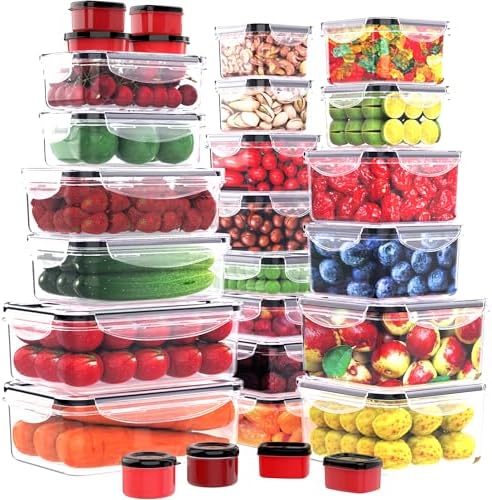
- VARIETY WITH MORE CAPACITY: Large sized containers perfect for main course, 28 containers with 28 lids of variable sizes…
- SPACE-SAVING STACKABLE DESIGN: These Apartment essentials for first Apartment & crystal-clear plastic food containers ar…
Why it helps:
Uniform containers can make irregularly packaged dry foods easier to stack.
Where to use it:
For suitable dry staples such as rice, pasta, flour, cereal, or other foods that benefit from sealed storage.
Before buying:
- Check the capacity.
- Look for secure lids.
- Confirm the containers are suitable for the intended food.
- Measure your shelves before buying a large set.
- Avoid buying more containers than you can realistically use.
Containers should simplify storage, not create another collection of items that needs its own cabinet.
11. Use the Refrigerator Efficiently
The problem
Refrigerator shelves can become crowded quickly, particularly when small jars and containers disappear behind larger items.
Why it happens
Different food packages have different shapes and heights. Without grouping, usable shelf space becomes difficult to manage.
Practical solution
Use refrigerator bins to group similar items.
For example, one bin can hold sauces and condiments while another can hold smaller snack items. Slim organizers can also make narrow areas easier to use.
Useful product: Refrigerator Storage Bins

- 【STACKABLE DESIGN】The lifting feet at the bottom of each freezer organizer bin can be stacked, stacked, or side by side …
- 【PORTABLE HANDLES】 Easy grip handles make these refrigerator organization containers portable. The handles make it easy …
Why it helps:
They group loose items and make it easier to remove several related products together.
Where to use it:
Refrigerator shelves where the bin fits securely and does not interfere with airflow or the door.
Before buying:
- Measure shelf depth and width.
- Check the bin height.
- Make sure refrigerator doors can close properly.
- Avoid blocking vents.
- Do not overload shelves or bins.
Organization should never come at the expense of safe refrigerator operation.
12. Create a “Use It Every Day” Zone
The problem
Many kitchens store everyday items in inconvenient locations while rarely used objects occupy the easiest-to-reach shelves.
Why it happens
Kitchen storage tends to develop gradually rather than being planned around daily routines.
Practical solution
Create one easily accessible zone for the things you use constantly.
For example, your everyday zone might contain:
- Two or three frequently used cooking utensils
- Everyday plates and bowls
- Common spices
- Cooking oil
- Measuring tools
- Your most-used cutting board
Keep these items close to the part of the kitchen where they are used.
Rarely used baking equipment, specialty gadgets, and seasonal serving pieces can move to higher or less convenient storage.
This simple change can make small kitchen organization much easier because the kitchen starts working around your habits rather than forcing you to search for everything.
Small Kitchen Storage Mistakes to Avoid
Good kitchen storage solutions are not simply about adding more organizers. They are about making the existing space easier to use.
Avoid these common mistakes.
Buying organizers without measuring
A product can look perfect online and still be completely wrong for your cabinet.
Measure:
- Width
- Depth
- Height
- Door clearance
- Shelf clearance
- Pipe clearance where applicable
Filling every empty space
Empty space is not automatically wasted space.
Some clearance is necessary for opening doors, removing items, cleaning, and moving your hands around storage.
Keeping rarely used appliances within easy reach
If you use an appliance twice a year, it probably should not occupy your prime countertop or eye-level cabinet space.
Using oversized containers
Large bins can actually reduce usable storage if they leave awkward gaps.
Stacking daily-use items too high
If you need to remove five things before reaching the one you use every morning, the storage arrangement is working against you.
Buying too many single-purpose organizers
Before purchasing another organizer, ask whether one adjustable product could solve several related problems.
Ignoring vertical space
Walls, cabinet doors, vertical cookware storage, and shelf risers can provide useful storage without increasing the kitchen’s footprint.
Blocking doors and drawers
Always test the full movement of doors and drawers after installing an organizer.
A Simple 30-Minute Tiny Kitchen Storage Reset
You do not need to reorganize the entire kitchen in one day.
Use this quick reset to identify the biggest opportunities.
Minutes 1–5: Remove obvious clutter
Take out:
- Expired food
- Empty containers
- Broken tools
- Duplicates you never use
- Items that belong somewhere else
Do not start buying organizers yet.
Minutes 6–10: Group similar items
Put similar things together.
Create basic groups such as cookware, utensils, food storage, baking, breakfast foods, cleaning supplies, and everyday dishes.
Minutes 11–15: Identify wasted spaces
Look for:
- Empty wall areas
- Cabinet doors
- Deep shelves
- Awkward corners
- Under-sink gaps
- Unused vertical height
- Crowded drawers
These areas are where your most useful tiny kitchen storage ideas will come from.
Minutes 16–20: Measure key areas
Measure the spaces where you are considering an organizer.
Write down the measurements on your phone.
Pay particular attention to cabinet depth and door clearance. These measurements can prevent many bad purchases.
Minutes 21–24: Move rarely used items
Move specialty gadgets and seasonal items away from prime storage locations.
Your most accessible spaces should contain the things you use most often.
Minutes 25–27: Add only necessary organizers
Choose products based on specific problems.
For example:
- Deep cabinet → pull-out organizer
- Awkward corner → rotating organizer
- Under sink → adjustable organizer
- Crowded cookware cabinet → vertical pan organizer
- Empty wall → rail with hooks
Minutes 28–30: Create your everyday zone
Place your most frequently used kitchen items where they are easiest to reach.
Group items according to your routines rather than simply by category.
The goal is a kitchen where you can quickly answer, “Where does this go?” and “Where is the thing I need?”
How to Choose Space-Saving Kitchen Storage Products
Not every organizer deserves a place in a tiny kitchen.
Before purchasing one, ask five questions:
- What exact problem does it solve?
- Where will it go?
- What will I store in it?
- Have I measured the available space?
- Will it make the item easier to access?
A product that adds capacity but makes everything harder to reach may not actually improve your kitchen.
Prioritize adjustable products when your storage dimensions are unusual. For cabinets, measurements are usually more important than appearance. For wall-mounted products, installation method and weight capacity matter. For drawers, internal measurements and divider height are critical. The most effective space-saving kitchen storage often comes from making one awkward area easier to use rather than trying to add storage everywhere.
FAQs About Tiny Kitchen Storage
How do I maximize storage in a tiny kitchen?
Start by measuring your existing cabinets, drawers, walls, and awkward areas. Then identify where access is difficult or vertical space is unused. Use targeted organizers such as pull-out baskets, cabinet-door storage, drawer dividers, and vertical cookware racks only where they solve a specific problem.
How can I organize a tiny kitchen without adding cabinets?
Use existing surfaces more effectively. Cabinet doors, walls, deep shelves, corners, and vertical cabinet space can all provide additional storage. A wall rail, slim door organizer, shelf riser, or pull-out basket may increase usable capacity without installing another cabinet.
What is the best way to use vertical space in a small kitchen?
Use vertical space for lightweight, frequently used items that are currently taking up counter or drawer space. Wall rails, hooks, vertical pan racks, shelf risers, and carefully selected hanging baskets can all help.
How do I organize a tiny kitchen with no pantry?
Create food zones inside your existing cabinets. Stackable bins can group snacks and packets, while suitable airtight containers can organize dry staples. A slim rolling storage cart may also work in an unused gap if it does not block doors or walkways.
How can I make more counter space in a small kitchen?
First remove rarely used items from the countertop. Then relocate suitable everyday tools to wall storage or cabinet organizers. A compact shelf riser or vertical holder can also use height rather than consuming additional counter width.
What storage products are useful for a tiny kitchen?
Useful products depend on the problem. Pull-out cabinet organizers help with deep cabinets, rotating organizers help with corners, adjustable under-sink organizers work around plumbing, drawer dividers control loose utensils, and vertical pan organizers separate cookware.
How do I organize a small kitchen on a budget?
Start with decluttering and rearranging before buying anything. Measure your storage and choose one or two organizers that address your biggest problems. Reusing suitable containers and grouping similar items can improve organization without requiring a complete set of new products.
How do I make small kitchen cabinets hold more?
Improve accessibility before trying to increase capacity. Shelf risers can use unused vertical height, pull-out organizers can make deep areas accessible, and door organizers can use otherwise empty surfaces. Avoid packing cabinets so tightly that doors cannot close or items become difficult to remove.
Conclusion
A small kitchen does not have to feel permanently overcrowded. The key is to stop treating every cabinet and countertop as a single block of storage.
Look at the kitchen from a different angle. Use the walls when appropriate. Turn cabinet doors into slim storage areas. Make deep cabinets pull forward. Give awkward corners a rotating surface. Organize cookware vertically and create a dedicated zone for everyday items.
Most importantly, buy storage products because they solve a real problem—not because they look useful in a product photo.
When you measure first, remove unnecessary clutter, and organize around the way you actually cook, it becomes much easier to maximize storage in a tiny kitchen without making the room feel packed.
-
Laundry and Cleaning Closet Organization: 15 Smart Ideas for a Neater Home
Transform a cluttered utility closet with practical laundry and cleaning closet organization ideas. Learn how to use shelves, doors, vertical space, carts, caddies, and smart storage products for a more functional home.
-
Small Bedroom Storage Ideas: 25 Smart Ways to Maximize Every Inch
Make the most of limited space with these practical small bathroom organization ideas. Discover smart storage solutions for countertops, cabinets, showers, walls, and awkward corners, plus useful products that help keep your bathroom tidy without taking up valuable floor space.
-
21 Pantry Organization Ideas to Make Your Kitchen Easier to Use
A messy pantry can make cooking and grocery shopping harder than they need to be. These practical pantry organization ideas show you how to create useful zones, improve visibility, maximize small spaces, organize deep shelves, and choose pantry storage solutions that actually fit your kitchen.
-
Best Laundry Hamper: Smart Picks for Every Home and Laundry Space
Find the best laundry hamper for your routine with practical advice on capacity, sorting, and style. Compare a large laundry hamper, divided designs, three-section options, and wicker hampers for different rooms.
-
Home Laundry Essentials: The Complete Checklist for an Easy Laundry Setup
Build a simple, practical laundry setup without buying unnecessary products. This complete checklist covers home laundry essentials for beginners, new homes, families, and small spaces.
-
7 Best Fabric Shavers for Removing Pilling, Fuzz, and Lint From Clothes
A fabric shaver can make worn sweaters, clothes, blankets, and other textiles look fresher by removing unwanted pills and fuzz. Here are seven practical types to consider.

Add a Comment