

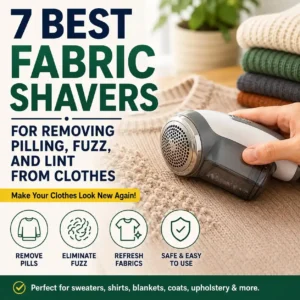

A sweater can still be perfectly comfortable and wearable while looking far older than it really is. Small balls of fiber appear around the sleeves, sides, and front, while blankets and frequently used furniture can develop a fuzzy, tired-looking surface.
That is where a fabric shaver can be useful. Instead of replacing clothing simply because it has developed surface pilling, you can remove those raised fibers and give suitable fabrics a cleaner appearance.
The right choice depends on what you plan to use it for. A compact battery model can make sense for occasional clothing touch-ups, while a rechargeable model with a larger shaving area may be more practical for frequent household use. A manual fabric comb can also be a sensible choice when you want slower, hands-on control.
The important thing is not to buy the gadget with the longest feature list. Choose a tool that matches your fabrics, laundry habits, storage space, and preferred power source.
Affiliate Disclosure: This article may contain affiliate links. If you purchase through an affiliate link, the site may earn a commission at no additional cost to you.
What Is a Fabric Shaver?
A fabric shaver is a small tool designed to trim raised fibers from the surface of suitable fabrics. Instead of pulling pills away like adhesive tape, its guarded cutting mechanism removes the loose fiber buildup.
Those little balls are commonly called fabric pills. They develop when fibers become loose and tangled through everyday friction, such as rubbing against other clothing, furniture, bags, or repeated washing.
A suitable fabric defuzzer can be useful on sweaters, shirts, coats, blankets, cushions, and some upholstered surfaces. The important word is suitable because not every fabric should be treated with an electric cutting tool.
Always check the garment’s care instructions and, when uncertain, test a hidden section before working across the visible area.
Table of Contents
7 Best Fabric Shavers to Consider
There is no single fabric shaver that is perfect for every household. The seven options below represent useful product categories to consider rather than seven claims that one particular design is universally superior.
1. Rechargeable Multi-Blade Fabric Shaver
Best for: Frequent clothing and household fabric care.
A rechargeable model is convenient when you expect to use your shaver regularly. Instead of depending on disposable batteries, you charge the device and keep it ready for the next clothing-care session.
Key features:
- Rechargeable operation
- Multiple cutting blades
- Removable lint collection area
- Cordless handling
- Ergonomic body

Why consider it: It offers the convenience of cordless use without requiring you to keep replacing ordinary batteries.
Possible drawback: You need to remember to charge it before a larger job.
Best use: Everyday clothing, sweaters, blankets, and general household fabric maintenance.
2. Battery-Operated Two-Speed Fabric Shaver

Best for: Occasional users who want simple operation.
A battery-powered clothes shaver can be appealing if you do not want another rechargeable device in your home. Models with different operating speeds can also provide more flexibility when moving between everyday fabrics.
Key features:
- Replaceable batteries
- Simple cordless operation
- Adjustable speed on applicable models
- Compact construction
- Lint collection chamber
Why consider it: It is straightforward and convenient for occasional touch-ups.
Possible drawback: Regular users need to keep suitable replacement batteries available.
Best use: Shirts, sweaters, coats, and small fabric-care jobs.
3. Large-Head Fabric Shaver for Sweaters and Blankets

Best for: Larger garments and broad textile surfaces.
A large shaving head can cover more fabric with each pass. That can be useful when you are dealing with a long sweater, blanket, throw, or another relatively large textile.
Key features:
- Broad shaving surface
- Comfortable grip
- Collection chamber
- Electric operation
- Suitable coverage for larger items
Why consider it: Less surface area needs to be treated manually compared with a very compact shaver.
Possible drawback: The larger body may not be as convenient to store or travel with.
Best use: Sweaters, coats, blankets, and larger clothing items.
4. USB-C or USB Rechargeable Fabric Defuzzer

Best for: People who prefer convenient rechargeable equipment.
A USB-rechargeable fabric defuzzer can be useful if you already keep charging cables around your home. It also avoids the need to purchase disposable batteries for ordinary use.
Key features:
- USB charging
- Cordless operation after charging
- Compact design
- Lint collection
- Easy storage
Why consider it: Charging can fit naturally into an existing electronics routine.
Possible drawback: You need access to the appropriate charging cable or power source.
Best use: Everyday clothing, sweaters, and compact home fabric-care tasks.
5. Dual-Power Fabric Shaver for Clothes and Upholstery

Best for: Homes where one tool needs to handle different textile jobs.
Some fabric shavers are designed around flexible power arrangements and broader household applications. This type can be useful when you want to work on clothing as well as larger surfaces such as cushions or certain upholstery.
Key features:
- Flexible power arrangement
- Household-fabric versatility
- Lint collection
- Comfortable handling
- Suitable for larger fabric areas
Why consider it: You may not need separate tools for clothing and occasional fabric furniture maintenance.
Possible drawback: More versatility can mean a larger or less travel-friendly design.
Best use: Clothing, blankets, cushions, and suitable upholstery.
6. Compact Portable Fabric Shaver

Best for: Travel, dorm rooms, and small homes.
A portable fabric shaver is useful when storage space is limited or you only need to refresh a few garments at a time. Its smaller footprint can also make it easier to keep with clothing-care supplies.
Key features:
- Compact size
- Lightweight handling
- Cordless operation
- Small storage footprint
- Easy to carry
Why consider it: It takes up little room and can be convenient for quick garment maintenance.
Possible drawback: A smaller shaving area can make large garments more time-consuming.
Best use: Travel, apartments, dorms, sweaters, and quick touch-ups.
7. Manual Fabric Shaver or Sweater Comb

Best for: People who want maximum control over small areas.
Not every fabric-care job requires an electric motor. A manual sweater shaver or fabric comb lets you work slowly across the material and control the amount of pressure yourself.
This can be especially useful when you prefer a simple tool without batteries, charging, or electrical components.
Key features:
- No batteries
- No charging
- Lightweight
- Compact
- Direct manual control
Why consider it: It is simple to store and gives you a very hands-on approach to removing surface pills.
Possible drawback: Treating a large blanket or several garments takes more effort.
Best use: Small areas, careful garment maintenance, and users who prefer manual tools.
How to Choose the Best Fabric Shaver
The best electric fabric shaver is the one that gives you enough control and coverage for the fabrics you actually maintain. More features do not automatically mean better results.
Blade Count and Cutting Area
Blade configuration can affect how much surface the tool covers and how efficiently it handles raised fibers. However, do not judge a device by blade count alone.
The design of the protective mesh, cutting mechanism, head size, and fabric-contact control can all affect how practical the tool is.
For large blankets, broader coverage can save time. For sleeves, collars, or small areas, a compact head may be easier to control.
Power Source
The most common choices are battery-operated, rechargeable, corded, and dual-power designs.
A battery operated fabric shaver can be convenient when you want replaceable power. A rechargeable model can make more sense if you use the tool frequently. Corded designs avoid charging concerns but reduce freedom of movement.
Speed Settings
Adjustable speed can be useful when you work with different fabrics or want more control.
A slower setting may be preferable for careful work, while a faster setting can help when covering larger suitable surfaces. Always follow the manufacturer’s instructions rather than assuming the highest setting is appropriate for every material.
Shaving Head Size
Think about the biggest item you will regularly treat.
A smaller head can be easier to maneuver around sleeves, collars, and small garments. A larger head can make blankets and broad sections of clothing less tedious.
Lint Collection
A good collection container makes maintenance easier. You should be able to see when it is becoming full and empty it without creating a mess.
This is a small feature that becomes surprisingly important after several uses.
Fabric-Contact Adjustment
Some models offer a way to control how closely the cutting mechanism works against the fabric. This can provide extra control when moving between materials.
However, adjustable settings do not make a product automatically safe for every fabric. Follow the device instructions and garment-care label.
Handle Comfort
A fabric shaver may look like a quick five-minute gadget until you decide to refresh several sweaters or a large blanket.
A comfortable handle helps you maintain a steady grip and controlled movement during longer sessions.
Replacement Parts
Before purchasing, check whether the design supports replacement cutting components or other maintenance parts when applicable.
A device that can be maintained over time may be more practical than one that must be replaced as soon as a key component wears out.
Which Fabric Shaver Is Best for Different Needs?
| Need | Recommended Type | Why |
| Everyday clothes | Rechargeable or battery model | Convenient for regular touch-ups |
| Sweaters | Adjustable electric model | Good balance of control and speed |
| Large blankets | Large-head fabric shaver | Covers more surface per pass |
| Upholstery | Household-fabric model | Better suited to broader surfaces |
| Travel | Compact portable model | Easy to store and carry |
| Delicate fabrics | Manual fabric comb | Provides slower, hands-on control |
| Frequent use | Rechargeable multi-blade model | Convenient cordless operation |

The right fabric shaver for clothes does not necessarily need to be the same tool you would choose for upholstery. Match the size and control of the device to the job.
Can a Fabric Shaver Damage Clothes?
Yes, improper use can potentially damage fabric, which is why a little caution matters.
A fabric shaver removes raised fibers with a cutting mechanism. If you press too hard, repeatedly work one tiny section, catch a loose thread, or use the device on an unsuitable textile, you may cause unwanted damage.
Start by checking the garment’s care label. Then test the shaver on a hidden area before moving across the main surface.
Lay the item reasonably flat and move the device gently. Avoid forcing the shaver over seams, buttons, decorative details, loose threads, or areas where the cutting head could catch.
A clothes pill remover is a maintenance tool, not a replacement for proper fabric care. If the material is extremely delicate or the care label recommends professional cleaning, follow that guidance instead.
How to Use a Fabric Shaver Properly?
- Prepare the fabric. Make sure the item is dry and check its care instructions.
- Lay it flat. Use a clean, stable surface.
- Test first. Choose a small hidden section.
- Turn on the device. Select an appropriate setting when adjustments are available.
- Move gently. Glide over the surface without pressing aggressively.
- Check your progress. Stop periodically rather than repeatedly treating one area.
- Empty the collection chamber. Remove collected fibers when necessary.
- Clean the tool. Follow the manufacturer’s instructions.
- Store it safely. Keep it dry and protected between uses.

Fabric Shaver vs. Lint Roller
A fabric shaver and a lint roller may both belong in a clothing-care drawer, but they do very different jobs.
| Feature | Fabric Shaver | Lint Roller |
| Main purpose | Removes raised pills and fuzz | Picks up loose debris |
| Fabric pilling | Designed for it | Not its main purpose |
| Pet hair | Limited usefulness | Very useful |
| Loose lint | Can collect some | Excellent |
| Reusability | Designed for repeated use | Depends on design |
| Best use | Surface pilling | Hair, dust, and loose lint |
If your sweater has little balls of tangled fiber, a pill remover is the more appropriate tool.
If your trousers are covered with pet hair, dust, or loose lint, a traditional lint roller may be the better solution.
You may not need to choose between them. They solve different problems and can complement each other.

Common Fabric Shaver Buying Mistakes
The first mistake is choosing a very small head when you regularly need to refresh large garments. Compact devices are convenient, but broad surfaces can take considerably longer when the shaving area is tiny.
Another common mistake is ignoring the power source. If you use the device often, constantly replacing batteries may become less convenient than using a rechargeable model.
Do not overlook cleaning. A collection chamber that is awkward to remove can turn a simple fabric-care task into an annoying chore.
Comfort matters too. If the handle is difficult to hold steadily, controlling the device becomes harder during longer sessions.
Replacement parts are another consideration. If cutting components are replaceable, the tool may be more practical to maintain over time.
Finally, do not choose based only on price. An inexpensive model may be perfectly adequate for occasional sweater maintenance, while someone caring for numerous garments and household textiles may benefit from a more versatile design.
Frequently Asked Questions
What is a fabric shaver used for?
A fabric shaver is designed to remove raised pills, fuzz, and loose surface fibers from suitable textiles. It can be useful for sweaters, clothing, blankets, and some upholstered materials.
Does a fabric shaver remove lint?
A fabric shaver can collect loose fibers while removing pills, but a dedicated lint remover such as a lint roller is usually better for loose pet hair, dust, and surface debris.
Can a fabric shaver remove pilling from sweaters?
Yes. A sweater shaver can remove raised pills from suitable sweaters. Always check the garment-care instructions and test a hidden area before treating the entire item.
Are electric fabric shavers safe for clothes?
An electric fabric shaver can be appropriate for many fabrics when used correctly. Avoid excessive pressure and take care around seams, loose threads, decorative details, and delicate materials.
Is a rechargeable fabric shaver better than a battery model?
Neither is automatically better. A rechargeable fabric shaver is convenient for frequent users, while a battery model may appeal to someone who prefers replaceable power and simple operation.
What should I look for in a fabric shaver?
Consider the shaving-head size, power source, speed settings, lint collection, grip, fabric-contact adjustment, cleaning process, and replacement-part availability.
Can fabric shavers be used on furniture?
Some fabric shavers are suitable for certain upholstery and furniture textiles. Check the manufacturer’s instructions and test an inconspicuous section before treating a visible area.
How often should I clean a fabric shaver?
Clean the collection chamber and cutting area whenever fibers accumulate. Follow the product’s specific cleaning instructions and allow components to dry appropriately when required.
Conclusion
The best fabric shaver depends on what you need to maintain. A compact battery model works well for occasional clothing touch-ups, a rechargeable multi-blade design can suit frequent users, a large-head version makes sense for blankets, and a manual fabric comb gives you more direct control.
Before buying, think about the fabrics you own, the size of the areas you will treat, how often you expect to use the device, and whether you prefer batteries or rechargeable power.
For most households, a versatile rechargeable or battery-powered fabric shaver for clothes is a sensible starting point. If you also plan to refresh blankets or suitable upholstery, look for a design with enough coverage to make those larger jobs practical.
The goal is simple: choose a fabric-care tool that fits your routine instead of paying for features you will never use.

Add a Comment